
EPDM and TPO are single ply roofing materials used on low slope roofs and many flat roofs. They both act as a roofing membrane inside complete roofing systems-insulation, fastening method, flashing, and drainage details. The “best” choice isn’t universal. Climate matters, so does budget, and roof traffic changes what you should prioritize.
The last variable is the one people underestimate: installer skill. Two crews can install the same membrane and deliver very different results. EPDM is known for a long track record and cold-weather flexibility. TPO roofing is often chosen for reflectivity and energy goals on sun-exposed buildings. Pick the system that fits your roof and your contractor’s strengths.
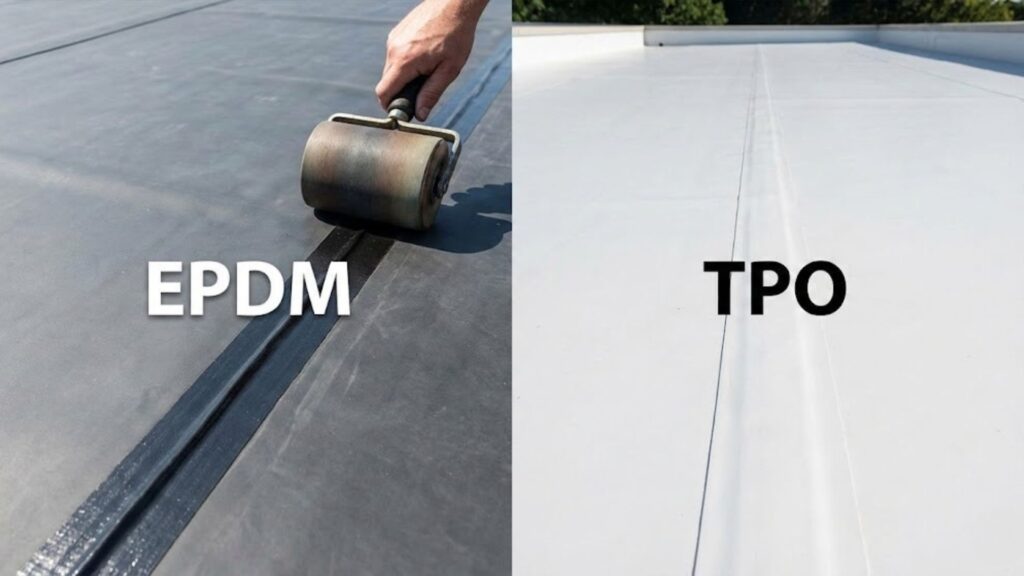
EPDM vs TPO on flat roofs: the core difference
The practical epdm vs tpo difference is what the sheet is and how the seams are created. EPDM is a synthetic rubber sheet; TPO is a thermoplastic sheet. EPDM seams usually rely on tape and pressure. TPO seams are fused with hot air, which creates a welded lap when done correctly. That’s not a small detail, because most leaks appear at seams, edges, and penetrations-not in the middle of the field membrane.
Both are roofing systems built around a roofing membrane layer. If the deck, insulation, slope-to-drain, and flashing are handled properly, both options can work on residential and commercial buildings.
EPDM roofing: ethylene propylene diene monomer rubber
EPDM roofing is made from ethylene propylene diene monomer (often shortened to EPDM). In specs you may also see ethylene propylene diene and ethylene propylene rubber, and sometimes the phrase epdm ethylene propylene diene appears in technical descriptions. EPDM is a synthetic rubber material derived from ethylene and propylene, which come from oil and natural gas feedstocks. It has been used since the 1960s, which is why people bring up longevity epdm in comparisons.
A core advantage is elasticity. EPDM roofing membranes are commonly cited as able to stretch significantly (up to about 300% in all directions) and then recover. That helps the membrane tolerate movement from temperature swings and building settling. EPDM roofs tend to perform well when the roof cycles through freezing and thawing.
TPO roofing – what thermoplastic polyolefin is
TPO roofing is a single ply roofing membrane made from thermoplastic polyolefin, usually described as a blend of polypropylene and ethylene-propylene rubber. It’s positioned as a modern alternative to older roofing materials, and it has become common on commercial and residential low-slope projects. You’ll hear contractors talk about tpo membranes in terms of thickness, reinforcement, and weld consistency.
TPO’s identity is tied to the seam method. The laps are designed to be fused with hot air rather than glued. When the welding is consistent, the seam can be a strong point of the system instead of a weak one. This is one reason many owners see TPO as an energy-focused, modern single-ply option.
Single-ply membrane basics
Single-ply roofs work because one continuous roofing membrane layer is the main waterproofing barrier. That membrane sits over insulation (and often a cover board), then ties into drains, edges, and penetrations. Thickness and sheet width matter because they influence durability and how many seams you create across a roof. Wider sheets can mean fewer seams, and fewer seams usually lowers leak risk over time.
Here’s the vocabulary that prevents bad bids and misunderstandings.
- Seams: overlap areas where sheets join
- Square inch: an easy way to picture total seam area across an entire roof
- Thickness: affects tolerance to wear, but doesn’t replace detailing
- Wider sheets: faster coverage and fewer field laps
- Adhesion / fasteners: how the membrane is held down
- “Mechanically attached” vs fully adhered: different movement and wind behavior
- Flashing: transition work that decides watertight performance
Single-ply is usually compared across EPDM, TPO, and pvc. PVC is another single-ply membrane family and shows up often in commercial specifications.
EPDM roofing systems – how they’re installed
EPDM roofing systems can be installed in several ways, and the attachment method changes how the roof behaves under wind, heat, and foot traffic. EPDM can be installed with bonding adhesives, it can be mechanically attached, or it can be weighted as ballasted epdm systems using gravel or concrete pavers. Seams in EPDM roofing systems are typically made with self-adhesive seam tapes, which makes surface prep and rolling pressure non-negotiable.
A real advantage is recover potential. On some buildings, EPDM can be installed over an existing roof assembly when conditions allow, reducing tear-off waste and disruption.
- Adhesive (often fully adhered) for many roofs with complex edges and terminations
- Fastened (mechanically attached) for speed on large open layouts
- Ballasted for wide commercial roofs where added weight is acceptable
- Hybrid installs based on perimeter zones and wind uplift design
- Recover installs to reduce landfill waste when the existing system is suitable
This is also where material choice matters. EPDM is rubber; TPO and pvc are thermoplastic families. Each behaves differently when attached and detailed.
TPO roofing systems: why heat-welded seams matter
TPO roofing systems are typically attached with adhesive or mechanical fasteners. The big difference is how the laps are closed. TPO uses heat welded seams made with hot-air equipment. When the settings, speed, and pressure are right, the lap becomes a fused joint. When the welding is rushed or dirty, you can end up with weak spots that open later.
Quality control matters because tpo seams are only as reliable as the weld consistency. “Welded” is not a guarantee by itself. A crew can create a bad weld just as easily as a good one.
- Sheets are positioned and aligned to reduce waste and avoid stress points
- Attachment is done by fasteners or adhesion depending on design
- Laps are cleaned and prepared for welding
- Seams are heat welded with hot air at controlled settings
- Welds are checked and repaired immediately
- Corners, penetrations, and edges are detailed last and inspected again
TPO is often praised for strong welded laps and good puncture resistance, but only when the installation discipline is there.
Roof deck reality check
Membranes don’t solve structural and drainage problems. The roof deck must be sound, dry, and compatible with the assembly. Wet insulation, soft spots, and poor drainage will shorten the life of any of these roofing options-EPDM, TPO, or pvc.
This is where “easy to install” becomes misleading. Both EPDM and TPO can be installed quickly, but quick doesn’t mean correct. Proper installation is about details: drain bowls, edge terminations, wall flashings, and penetrations. One missed termination can become a leak path that looks “random” later. If you want reliability, you evaluate the deck condition, insulation plan, and water flow before you choose a membrane.
Energy efficiency and reflectivity
If you care about energy efficiency, the roof surface matters because it drives heat gain. EPDM is commonly black. Black membranes absorb heat, which can raise cooling costs in hot regions. That’s one reason some owners avoid black EPDM in strong summer sun unless they have good insulation and limited cooling loads. EPDM also has strong uv resistance, often described as outstanding resistance to long-term uv radiation exposure.
TPO is often white or light-colored and is used for reflecting uv rays. In warmer climates, that reflectivity can lower roof surface temperature and reduce cooling costs. In colder climates, reflectivity is less of a selling point, and the tradeoff shifts toward durability, detailing, and overall insulation performance. If you’re thinking about heating costs, insulation and air sealing usually move the needle more than membrane color.
Are EPDM and TPO environmentally friendly?
People ask whether these membranes are environmentally friendly. In practice, it’s not one clean answer. EPDM and TPO can reduce landfill waste if the project is eligible for a recover install instead of a full tear-off. Both can be used under green roof assemblies when the design and drainage are correct.
Recyclability depends on local programs and jobsite realities, but the bigger sustainability lever is lifespan and fewer repairs. When you evaluate tpo and epdm, consider what will actually happen on your building: tear-off volume, expected service life, and how the roof will be maintained.
TPO vs EPDM cost per square foot
For most owners, tpo vs EPDM becomes a budget decision once the performance needs are clear. Typical installed pricing is often quoted around $4-$11 per square foot for EPDM and $5-$14 per square foot for TPO. Those numbers move based on roof size, complexity, and scope.
Price drivers that matter in real bids include tear-off vs recover, insulation thickness, edge metal and flashing quantity, roof access, and local labor rates. A simple rectangle on a warehouse is different from a rooftop packed with units and penetrations. Material price is only one line item. Labor and detailing usually decide the final number, especially when the job is complex or labor intensive.
Disadvantages of EPDM roofing
The real downsides of EPDM aren’t mysterious. They usually show up at seams and maintenance. EPDM seams rely on tapes and adhesives, and those areas can need periodic attention. When surface prep is rushed, seam performance suffers. Over time, some roofs need resealing at details, especially where movement is frequent.
EPDM can also show staining and dirt accumulation more than light membranes. If drainage is poor and ponding water is common, the roof can stay dirty and damp, which increases the chance of mold growth or mildew on the surface. That’s not a reason to panic, but it is a reason to take drainage and cleaning seriously. EPDM can be highly durable, but traffic and sharp tools can still cause punctures without protection pads and proper maintenance.
Cons of TPO roofing: choose your new roof with a checklist
TPO’s biggest risk is inconsistency. Formulations and reinforcement vary by manufacturer, and long-term history is still shorter than EPDM’s decades of use. Performance depends heavily on workmanship because the roof’s watertightness relies on welding quality. Bad welds don’t always fail immediately. They can open after seasonal movement, wind uplift, or repeated foot traffic-classic consequences of poor installation.
TPO is often seen as energy efficient and can offer strong seam performance because joints are heat welded, but that advantage only shows up when the crew controls the process. If you’re choosing a new roof, use a simple checklist and compare proposals by scope and details, not just brand names.
- Climate and sun exposure (hot, mixed, or freeze-heavy regions)
- Foot traffic level and walkway pad plan
- Reflectivity goals and energy targets
- Budget range and what’s included in the scope
- Deck condition and moisture findings
- Insulation thickness and drainage corrections
- Contractor skill with welding vs tape-based seams
- Warranty terms and what voids coverage
- Maintenance plan and access rules
- Timeline and disruption to the building
FAQ
Which is better TPO or EPDM?
Neither is universally better. EPDM often wins on long track record and cold-weather flexibility; TPO often wins when reflectivity and energy efficiency goals matter in hot regions. Installer quality is the deciding factor.
How much is TPO vs EPDM?
Typical installed ranges are about $4-$11 per square foot for EPDM and $5-$14 per square foot for TPO, but tear-off, insulation, and roof complexity can shift the number.
What are the disadvantages of EPDM roofing?
Seam tapes/adhesives can require periodic attention, black surfaces can increase cooling costs in hot regions, and poor drainage can lead to dirt accumulation and maintenance issues, including occasional mold growth.
What are the cons of TPO roofing?
Seams rely on correct hot-air welding, product quality can vary, and very long-term durability is still less proven than EPDM’s decades-long history.
Does EPDM last longer than TPO on average?
Often yes. EPDM is commonly cited around 20-30+ years (sometimes longer with proper maintenance), while TPO is often cited around 15-25 years. Real lifespan depends on proper installation, details, and how the roof is used.