Choosing a roof is not just picking a color or copying a neighbor’s upgrade. The right choice depends on climate, budget, expected lifespan, and the shape of your roof. Weight matters because some roofing materials push the roof structure beyond what it was built to carry. Maintenance matters because low maintenance is rarely zero. And in 2026, more homeowners compare upfront cost with long-term performance – especially weather resilience. Wind, hail, humidity, and UV rays shorten service life when the chosen material is a poor match.
Local building codes and insurance rules also shape your roofing options, including fire ratings and “cool roof” energy efficiency requirements. The goal is practical: pick a roof that fits your home, lasts as expected, and doesn’t turn into a cycle of future repairs.
Start with your home and roof shape
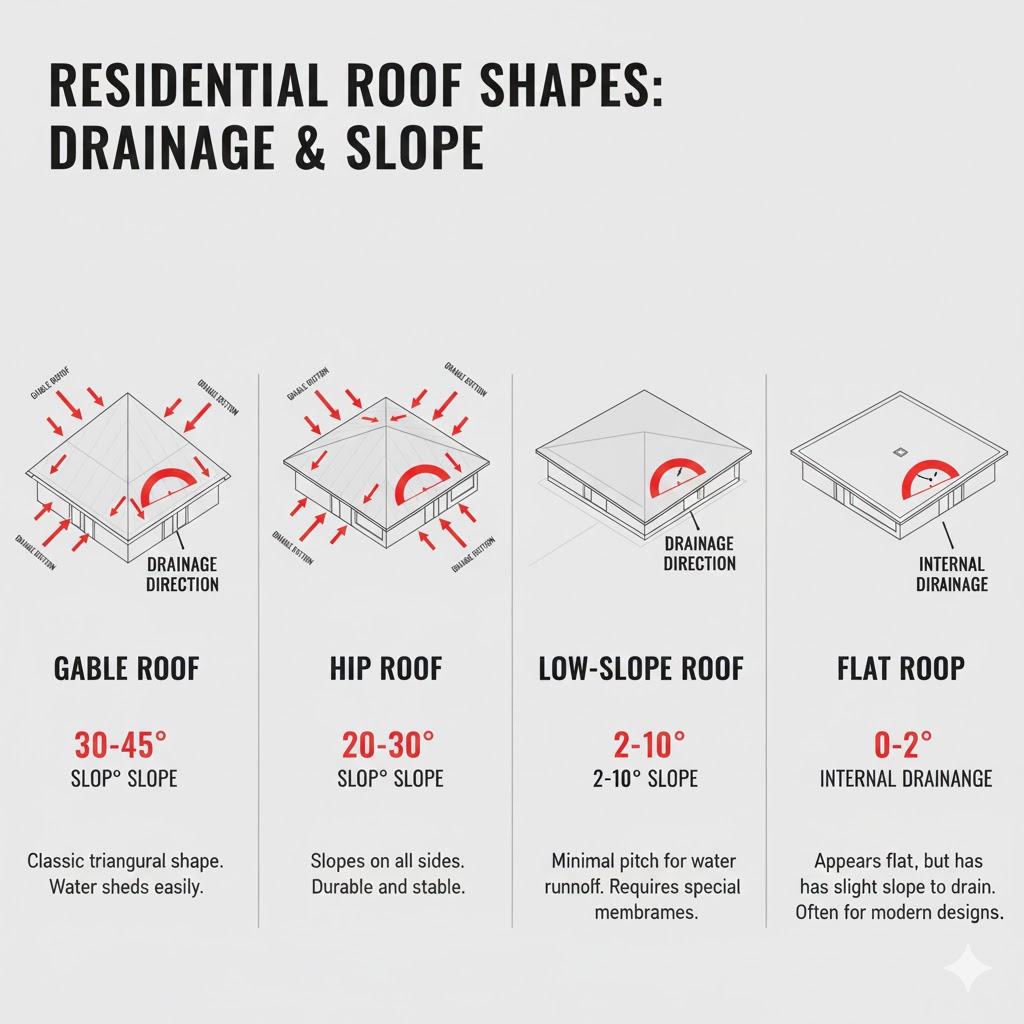
Roof shape limits what can be installed correctly. Pitched roofs shed water quickly and tolerate more roofing types. Low sloped roofs and flat roofs hold water longer, so they demand systems built for slower drainage and tighter detailing. That includes how seams are handled, how edges are protected, and how penetrations are flashed.
A simple rule holds up in real projects: steep roofs are forgiving, low slope roofs are picky, and true flat roofs require a complete roofing system-not a “close enough” adaptation. If you force the wrong roofing materials onto the wrong geometry, you often pay later through leaks and costly repairs.
Roof forms and best matches:
- Gable and hip (pitched roofs): flexible; works with asphalt shingles, metal roofing, slate tiles, and tile when framing allows.
- Steeper slopes: shed water and debris well; good for traditional shingles, wood shingles, and slate roofs with proper detailing.
- Low sloped roofs: need careful product choice; many materials fail if the installation methods don’t match slope limits.
- Flat roofs: depend on drainage and watertight layers; details and transitions matter more than the “field” area.
Weather-driven performance: what your region does to roofs
Local weather is the real deciding factor because it controls aging. In hot climates, UV rays and heat cycling dry out materials and accelerate wear. In humid areas, moisture and shade can drive algae, rot, and fastener issues. In coastal zones, salt air speeds corrosion if finishes are wrong.
Storm-prone areas raise the stakes. High wind uplift ratings matter when gusts hit roof edges and corners. Hail is a direct impact test; the wrong roof can look fine until the first big storm forces a roof replacement.
If you want the shortest version of this: climate decides the “safe” materials list, and aesthetics should be chosen inside that list-not outside it.
How to choose the right roofing material: the homeowner checklist
Choosing the right roofing requires careful consideration, but the process is not complicated if you keep it in order. Start with budget, then climate, then durability, then weight, then maintenance requirements. After that, choose looks that fit the home’s architectural style. This is how you avoid picking something that is pretty but wrong.
Homeowners in 2025 often compare initial cost with total ownership. That includes labor costs, future repairs, and energy efficiency impacts. A roof that costs less today but triggers recurring repairs can become the expensive option. The right roofing material is the one that matches your climate and your tolerance for upkeep, while meeting local building codes.
The decision checklist + contractor checks:
- Budget limits: set a max upfront cost and a separate long-term comfort zone for repairs and upkeep.
- Climate risks: heat, hail frequency, wind exposure, humidity, salt air, tree cover, falling debris.
- Lifespan target: 20-30 years vs 50+ years changes the right roofing choice.
- Roof structure limits: confirm if heavy materials might necessitate reinforced framing.
- Local building codes: fire ratings, ventilation rules, ice barriers, and “cool roof” requirements.
- Aesthetic goals: align with architectural style so the roof looks intentional.
- Maintenance tolerance: decide if you want minimal maintenance or you’re fine with regular work.
- Installer capability: ask what systems they install most and request proof of similar jobs.
- Scope clarity: demand a written scope for flashing, edges, vents, and deck repairs.
Roofing materials in plain terms
Most residential properties fall into a familiar group of popular roofing materials. Asphalt shingles are the common roofing material and the most common roofing material in the U.S. for a reason: broad availability and a manageable upfront cost.
Metal roofing is popular when longevity and storm resilience are priorities. Clay tiles and concrete tiles often show up in sun-heavy regions because of heat performance and fire resistance. Slate roofs and natural slate target maximum lifespan, but weight and specialized labor change the project. Wood roofing delivers a natural material look but brings higher maintenance requirements and fire restrictions in many areas. Composite roofing and synthetic materials cover the middle ground: a “natural look” with more predictable performance and often less weight.
You will also see other roofing materials in niche roles-rolled roofing on low-value roofs, green roofs for insulation and runoff control, and specialty systems designed around specific climates. These can be smart, but only when the roof type and budget justify them.
What should a 2,000 sq ft roof cost?
A 2,000 sq ft roof is often priced by the “square” (100 sq ft), so you’re roughly at 20 squares before waste and complexity. That’s why “price per square” and “project total” can differ fast. Steepness, multiple facets, valleys, chimneys, skylights, and tear-off layers all push labor costs and time.
Upfront cost is not the only cost. A cheap bid that cuts corners on underlayment, ventilation, or edge protection can lead to future repairs and interior damage. That’s when an “affordable” roof turns into costly repairs.
Below are practical cost ranges people actually see quoted. They are broad because local markets and roof complexity vary. Still, they give you a useful baseline for right roofing decisions.
Common roofing options by cost, lifespan, and climate fit
| Material | Typical installed cost | Typical lifespan | Key pros / cons | Climate notes |
| Asphalt shingles | $350-$950 per square | ~15-30 yrs | Low initial cost; many styles; easy to install. Shorter life; can struggle with heat, algae, and hail. | In humid areas, algae-resistant options help; impact-rated versions help in hail zones. |
| Metal roofing | $600-$1,800 per square | ~50-100 yrs | Long life; strong wind performance; can be energy efficient. Higher installation costs; repairs can be specialized. | Strong in storm-prone areas when high wind uplift ratings and detailing are correct. |
| Slate roofs | $1000-$3,500 per square | 75-100+ yrs | Extreme durability; premium curb appeal. Heavy; expensive; requires skilled crews. | Excellent long-term option if the roof structure supports the load. |
| Clay tiles | $1,000-$2,000 per square | 50-100+ yrs | Fire/rot resistant; strong aesthetic appeal. Heavy; breakage risk; needs proper underlayment. | A strong fit for hot climates due to durability and low moisture absorption. |
| Concrete tiles | $800-$1,600 per square | 50-100+ yrs | Durable; fire resistant; often lower cost than clay. Heavy; structure and fastening matter. | Good in heat; confirm fastening approach for wind zones. |
| Wood roofing | $700-$1,300 per square | ~20-40 yrs | Natural look; biodegradable; can add comfort. Fire restrictions; higher maintenance requirements; rot risk. | Needs careful moisture control; often a poor fit in wildfire-prone regions. |
| Synthetic composite shingles | $600-$1,300 per square | ~30-50 yrs | Mimics slate/wood; stable performance; often lighter than natural material. Quality varies by product. | Useful when you want premium looks with lower weight and low maintenance. |
Asphalt shingles: when the standard choice is enough
Asphalt shingles stay common because they solve the basic problem at a manageable price. For many homeowners, they’re the affordable option that still delivers curb appeal. They also work with many pitched roofs and typical residential detailing.
The difference is in the product tier. Three-tab shingles are budget-friendly but have the shortest lifespan. Architectural shingles are thicker and often more wind-resistant. In humid climates, algae-resistant choices are worth it because they keep the roof cleaner and reduce early degradation. If you’re in a hail area, impact-rated shingles can reduce damage frequency and may help with insurance acceptance.
The best outcome with asphalt is not “cheapest shingles.” It’s the right package for your region and your roof design.
Asphalt shingle upgrades worth paying for:
- Traditional shingles (3-tab): lowest price, simplest look, shortest service life.
- Architectural shingles: thicker profile and better curb appeal; often better in wind.
- Algae-resistant asphalt shingles: helpful in humid areas and shaded roofs.
- Impact-rated (Class 3 / Class 4) options: practical for hail exposure.
- Better underlayment package: adds backup protection that reduces leak risk.
Metal roofing: what you gain and what you trade off
Metal roofing is a strong choice when you want durability, wind performance, and a long service life. Many systems fall into the 50-100 year range. It can also support energy efficiency goals when color, ventilation, and insulation are handled correctly.
Still, metal is not magic. Poor detailing around penetrations and edges causes leaks. Some systems need attention to fasteners over time. Condensation control matters in certain climates. And noise perception depends on the roof deck, attic design, and insulation.
Standing seam is the premium profile for many homes. A standing seam metal roof handles thermal movement well and sheds water cleanly. Standing seam metal usually costs more but often performs better over decades. Metal shingles are another route when you want metal roofing without a “panel” appearance.
Metal roofing systems at a glance:
- Standing seam metal roof: premium look and performance; excellent for longevity.
- Standing seam metal: often preferred for wind performance with correct clips and fastening.
- Exposed-fastener panels: lower cost; works best on simple roof shapes; needs maintenance awareness.
- Metal shingles: residential look with metal durability; detailing still matters.
- Coated steel systems: used when extra texture and impact resistance are priorities.
Clay tiles and concrete tiles for sun-heavy regions
Clay tiles and concrete tiles are common in sun-heavy regions because they handle heat well and resist rot and fire. Clay tiles are known for low moisture absorption, which helps in hot climates with sharp day-night temperature swings. Many tile systems land in the 50-100+ year range when installed as a complete assembly.
The tradeoff is weight and complexity. Tile itself is not the only water barrier, and the underlayment and flashing details must be done correctly. Tile can be a cost effective choice if you plan to stay long-term, but only if the roof structure and installation quality match the system.
Tile also ties directly to architectural style. On the right home, it looks correct. On the wrong home, it can look forced and hurt aesthetic appeal.
Heavy roofs and roof structure limits
Weight is a deciding factor that people ignore until the engineer shows up. Slate roofs, natural slate, slate tiles, clay tiles, and concrete tiles can be heavy enough that reinforced framing becomes necessary. That adds cost, time, and sometimes design changes.
Slate is the classic long-life roof. It can last a century, but only if the roof structure supports it and the installer knows slate work. If you push slate onto a marginal structure, you risk sagging and long-term movement that damages flashings and fasteners.
Before you commit to heavy roofing types, confirm the framing capacity and deck condition. This is where “it looks great” can become “it’s not feasible” unless you’re willing to pay for the structural upgrade.
Wood roofing – beauty with maintenance
Wood roofing is chosen for looks. Cedar roofing, wood shingles, and wood shakes can match craftsman homes, cabins, and historic designs better than many other materials. You’ll also see slate and cedar shake used in higher-end design mixes where the roof is part of the home’s identity.
The cost is homework. Many areas restrict wood roofing for fire reasons, and local building codes may require treatments or may prohibit it. Moisture management is also key. Wood shakes can hold water and grow moss if ventilation is weak or trees shade the roof. Wood shake roofs can last 30-40 years with proper maintenance, but that maintenance is not optional.
If you want the look without the workload, composite shingles or synthetic slate often make more sense.
Composite roofing that looks like nature
Composite roofing exists because many homeowners want the look of slate or cedar without the weight or constant maintenance. Composite shingles often target a 30-50 year lifespan with stable performance. Many composite materials are designed to resist cracking, UV damage, and impact better than older “look-alike” products.
Synthetic materials also broaden your roofing options when structural limits block heavy choices. Synthetic slate can mimic slate tiles closely, without forcing reinforced framing. This is a common solution when you want premium curb appeal but need lower weight and low maintenance ownership.
Sustainability is part of this category, too. Some products include recycled materials and may be recyclable at end of life. If environmental impact matters to you, ask direct questions about recycled content, recyclability, and disposal.
Roof deck basics: plywood vs OSB
Your roof deck is the platform. If it’s compromised, even good roofing materials struggle. The plywood vs OSB choice is mostly about moisture behavior, fastener holding feel, and price. OSB is common and often cheaper. Plywood often holds fasteners better and can tolerate repeated wet/dry cycles with less edge swelling, depending on grade.
Local building codes may dictate thickness and fastening schedules. Your contractor should price deck replacement in a clear, per-sheet way and explain how much will be replaced if damaged sections appear during tear-off.
A practical rule: if the deck is likely to be exposed to rain during construction or your region is persistently humid, plywood can be the safer choice. In controlled installs with quick dry-in, OSB can be perfectly acceptable.
Class 3 vs Class 4 impact ratings
Impact classes exist because hail claims are expensive. Class 4 generally offers stronger impact resistance than Class 3 and is often the better fit in hail-prone and storm-prone areas. Class 3 can be enough when hail risk is moderate and budget is tighter.
Impact rating is only part of storm performance. Wind exposure matters just as much. High wind uplift ratings are essential in storm regions, and the rating only means something when the installation methods match the manufacturer’s spec. Metal roofing and Class 4 shingles tend to be strong choices where hail and wind are both real threats, but only if detailing and fastening are done correctly.
Energy efficiency and cool-roof planning
Roofing affects comfort and utility bills because it shapes attic temperatures and heat flow. Energy efficient roofs are not only about the roofing materials; ventilation and insulation do half the work. Still, surface reflectivity matters, especially in hot climates.
Reflective roofing options can reduce energy costs. A common reference point is that light-colored metal can cut cooling demand by about 10-25% when combined with decent ventilation. That’s one reason some local building codes include “cool roof” requirements in certain zones.
Solar panels add another layer. Solar panels change loading and introduce mounting details that must protect the roofing system. You want clarity on penetrations, flashings, and warranty coverage. Standing seam systems can be solar-friendly because clamp mounts may reduce penetrations, but the details still need to be done correctly.
The details that control lifespan
A roof rarely fails in the middle of a clean, open field. It fails at edges, penetrations, transitions, and ventilation mistakes. The quality of installation is as important as the chosen material itself. That’s why “cheap” quotes often become expensive later.
Proper underlayment is your backup water barrier. Ventilation controls heat and moisture. A ridge vent helps when intake ventilation exists and the system is balanced. Drip edge protects the deck edge and guides water into gutters instead of behind fascia. These details are not optional line items if you want long service life.
Detail items to lock into the bid:
- Proper underlayment: specify type, coverage, and where ice/water protection is used.
- Ventilation plan: intake and exhaust sizing; ridge vent scope when included.
- Drip edge and edge metal: written scope, fastening, and integration with underlayment.
- Flashing scope: chimneys, valleys, walls, skylights, pipe boots-no vague “as needed.”
- Fastening schedule: match wind zone requirements and deck type.
- Deck repair terms: per-sheet pricing and criteria for replacement.
Maintenance and longevity: keep your roof out of trouble
Every roof needs proper maintenance. Even “low maintenance” materials benefit from simple inspections and fast fixes. The point is not perfection. It’s stopping water before it turns minor damage into costly repairs. Maintenance requirements vary: asphalt shingles need checks after storms and for algae issues; some metal roofing systems need periodic fastener and sealant review; wood roofing needs cleaning and treatment; tile needs broken piece replacement and underlayment awareness.
If your roof is out of warranty and over 20 years old, planned roof replacement often beats endless patching. A roofing project goes better when it’s scheduled, not rushed after a leak.
Yearly roof care routine:
- Spring visual check: look for lifted shingles, cracked tiles, rust spots, and damaged flashing.
- Gutter cleaning: keep water from backing up under edges.
- After-storm inspection: check for hail hits, missing pieces, and punctures from debris.
- Branch control: trim overhangs to reduce impact and keep roofs drier.
- Attic check: stains, damp insulation, or musty smells signal moisture problems.
- Small repairs early: a loose flashing today can be a ceiling repair tomorrow.
What a real estimate must include:
- Material spec: exact product line, rating, color, and accessory system.
- Tear-off and disposal: layers included, dumpster fees, protection plan.
- Deck scope: inspection, replacement pricing, fastening upgrades for the roof deck.
- Labor costs: clear separation of labor and materials, not a single vague number.
- Ventilation scope: what changes, what stays, and why.
- Flashing and edges: written details for valleys, penetrations, drip edge, and wall transitions.
- Warranty terms: manufacturer coverage plus workmanship warranty in writing.
- Code compliance: permits and local building codes responsibility stated clearly.
FAQ
How much should a 2000 sq ft roof cost?
Costs vary by material, pitch, tear-off, complexity, and labor. Asphalt shingles are usually the lowest upfront cost. Metal, tile, and slate typically rise quickly, especially when structure work or premium detailing is needed.
Is it better to use plywood or OSB on a roof?
Plywood often performs better with moisture cycles and fastener holding, while OSB is common and usually cheaper. Choose based on exposure risk during install, local climate, and the deck spec required by local building codes.
Is class 3 or 4 shingles better?
Class 4 is usually better where hail risk is real and can matter for insurance. Class 3 can be enough in moderate zones. Either way, confirm wind uplift ratings and correct installation methods.
What type of roof is best for a hot climate?
Reflective metal roofing and well-installed tile (clay tiles or concrete tiles) often perform well in hot climates. Ventilation and insulation drive results, and “cool roof” rules may apply under local building codes.
How do I choose between asphalt, metal, tile, slate, and composites?
Use a short filter: climate first, then lifespan, then roof structure limits, then maintenance requirements, then budget and architectural style. That sequence usually lands you on the right roofing material without regret.